
Once California's largest milk-producing community
Concrete Contractors in Chino, CA
From older in-town homes to new tracts on old dairy ground, with slabs for shops, RVs and backyards.
- Free on-site estimates with measurements and a base check
- Written, itemized quote before any work starts
- Pours and curing planned around Inland Empire heat
Concrete on Old Farm Ground
Chino has been a city since 1910, and its farm history still shapes the work of concrete contractors here. From the 1950s through the 1980s, dairy farming flourished, and Chino was described as the largest milk-producing community in California. As dairies gave way to houses, the city grew fast: from 77,983 residents in 2010 to 91,403 in 2020, while housing units rose from 21,797 to 27,224. That mix of older homes and brand-new tracts means we see both worn-out concrete and young slabs in the same week.
Deep soil, flat ground
The Chino Valley sits on an alluvial plain with topsoil up to four feet deep, which once grew sugar beets, corn, walnuts and strawberries. Rich farm soil is great for crops and less great under a slab. Organic topsoil compresses and holds water, so we never pour on it. For driveways, patios and shop floors we strip down to firm ground, bring in a proper aggregate base and compact it in lifts. That step costs a little more time, but it is what keeps a slab from settling in the years after.
Flat ground also means water does not run off on its own. Each slab gets a steady slope toward a drain, the street or a landscape area.
Shops, RVs and working yards
Where a Chino lot has room for workshops, RV parking or equipment, the usual slabs are:
- Shop and garage slabs with thickened edges for wall loads
- RV and boat pads beside the house or behind a gate
- Driveway extensions that run down a side yard
- Equipment pads for generators, tanks and AC units
A working slab should be thicker than a patio, sit on a deeper base and use rebar. We size each one to the vehicle or equipment it will carry.
Heat in the valley
Chino's climate data shows a record high of 121 degrees, set in September, and an annual average high near 81. Rain is light, about 9.98 inches a year, peaking in February. Late-summer heat waves are the hardest time to place concrete well, so we start pours at first light, use cooler mix water where needed and cure the surface right away. If a pour falls in a September heat wave, we may suggest moving it a few days.
Older homes in town
When an older driveway or walk has been patched more than once, another layer of patch rarely holds. We usually recommend cutting out the failed panels and replacing them at full depth. For surfaces that are sound but stained and pitted, a resurfacing overlay or a good cleaning and sealing can bring them back for much less than a tear-out.
Backyards in new tracts
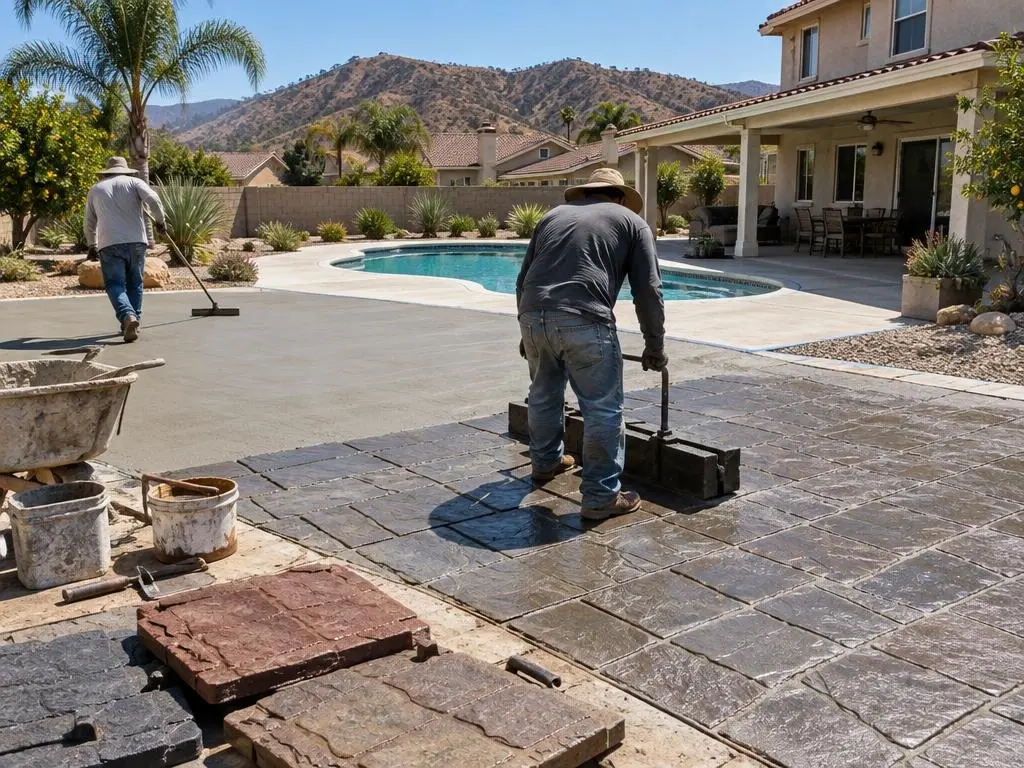
In the newer subdivisions on former dairy land, owners mostly want patios, stamped concrete and pool decks. Builders often leave small slabs, and families fill the yard quickly. We pour full-width patios, footings for covers, and pool decks with cooler, textured finishes. Stamped concrete gets sealed so it keeps its color in the sun.
Before any pour, we check with the City of Chino about permit needs for the specific work.
Getting water off a flat lot
Most of Chino sits on the flat valley floor, and flat ground is where drainage mistakes hide. A slab that looks level to the eye can still trap a puddle against the garage or the back door. We set forms with a string line and level rather than by eye, aim for a steady fall of roughly a quarter inch per foot away from the house, and check where that water ends up: a yard drain, the street, or a planting bed that can take it. On long driveways we sometimes add a shallow swale or a channel drain at the low point, and on patios that butt against a block wall we leave a gap or a drain line so water does not dam up behind the slab.
Chino Facts for Your Project
- Dairy capital past. Dairy farming flourished in Chino from the 1950s through the 1980s, and the city became the largest milk-producing community in California.
- Deep valley soil. The Chino Valley sits on an alluvial plain with fertile topsoil up to 4 feet deep, an agricultural center from the 1890s through the mid-20th century.
- Rapid home building. Housing units rose from 21,797 in 2010 to 27,224 in 2020, with 62.5% of occupied homes owner-occupied.
- Extreme heat on record. Chino's record high is 121°F, set in September, and annual rainfall averages about 9.98 inches.
Our Services in Chino, CA
Chino Questions
Why do you remove topsoil before pouring in Chino?
Chino's farm topsoil is deep and organic, and it compresses under load. We dig to firm ground and build a compacted aggregate base so the slab does not settle later.
How thick should a shop slab be?
It depends on what goes on it. A shop that holds a truck, a lift or heavy equipment needs a thicker slab and rebar compared with a patio. We size the slab and base after hearing how you will use it.
Can you pour concrete in Chino in September?
Yes, but September heat waves are real here. We pour early, cure right away and will suggest moving the date if extreme heat is forecast.
Free Estimates in Chino, CA
Free estimates across Chino, from older blocks to new tracts.
Concrete Contractors Near Chino
- Concrete Contractors in Corona, CA
- Concrete Contractors in Norco, CA
- Concrete Contractors in Eastvale, CA
- Concrete Contractors in Temescal Valley, CA
- Concrete Contractors in Riverside, CA
- Concrete Contractors in Chino Hills, CA
- Concrete Contractors in Yorba Linda, CA
- Concrete Contractors in Home Gardens, CA
- Concrete Contractors in Woodcrest, CA
- Concrete Contractors in El Sobrante, CA
- Concrete Contractors in Jurupa Valley, CA
- Concrete Contractors in Lake Elsinore, CA
- Concrete Contractors in Moreno Valley, CA
- Concrete Contractors in Perris, CA
- Concrete Contractors in Lake Mathews, CA
- Concrete Contractors in Anaheim, CA
- Concrete Contractors in Ontario, CA
- Concrete Contractors in Placentia, CA
- Concrete Contractors in Brea, CA
- Concrete Contractors in Orange, CA
- Concrete Contractors in Diamond Bar, CA